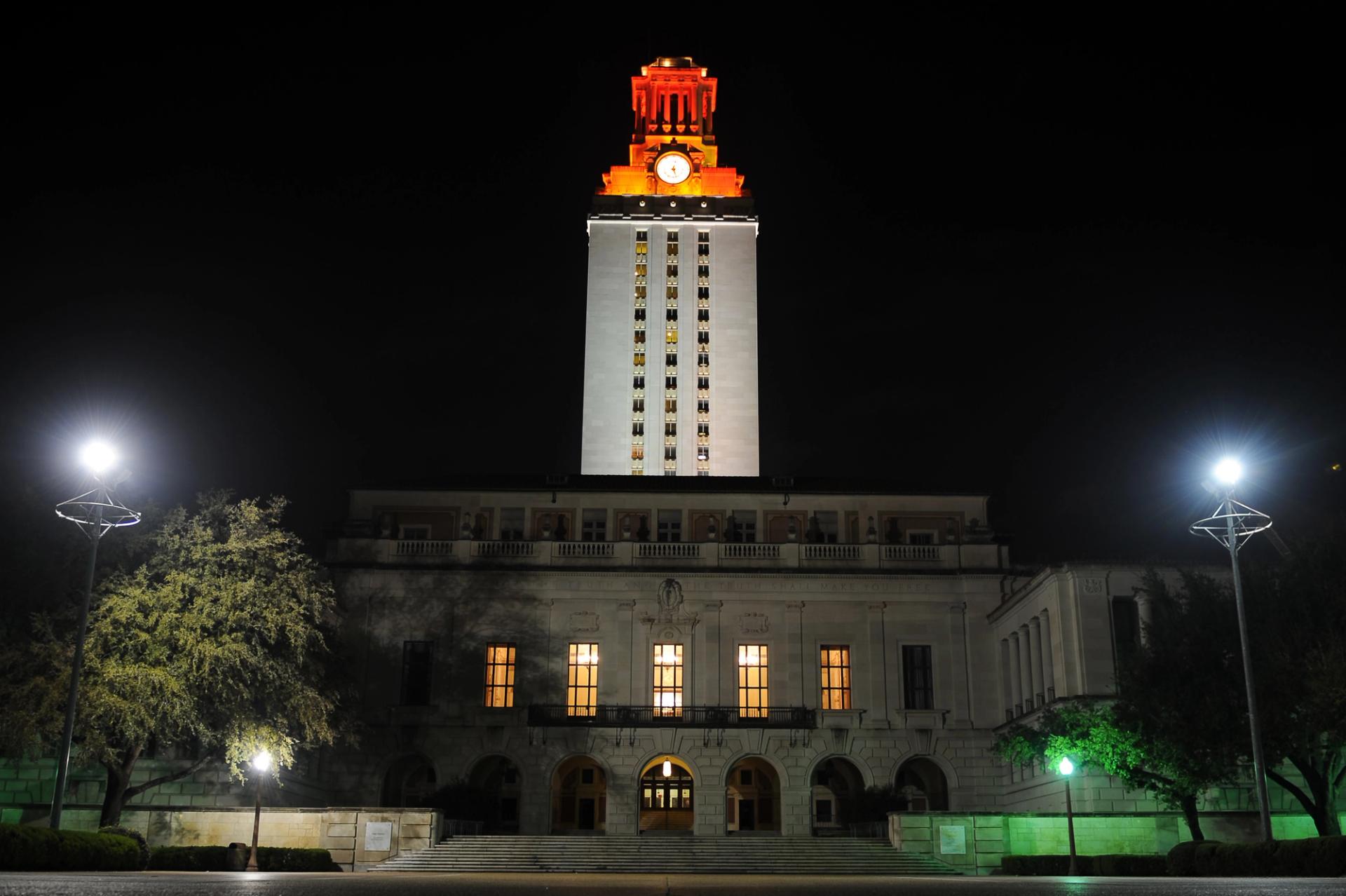
It’s nighttime, and the air in Austin is crisp, clear, and cool (c’mon, a girl can dream). You’re headed out on the town and something catches your eye near the center of town. You squint, and realize, yes, there really is an unusual yet comforting orange glow coming from the University of Texas tower.
It’s the glorious glow of victory.
For decades, the 307-foot tall tower has stood over the city of Austin. Officially opened in 1937, the campus’ main building and tower were designed by Paul Cret, a French architect, in the Spanish Renaissance style. Luckily, that included a facade of windows and a powerful lighting system with orange (and white) lights. That year, on October 19, the tower was lit for the very first time and the luminescence could be seen all the way in San Marcos.
The tradition was put on pause in 1942 and 1943 during World War II, only being illuminated twice for spring graduations, and a football win over Texas A&M University.
In the 1960s, the university began to use the tower’s windows in its light shows starting with spelling out “UT” to celebrate the football team’s no-loss record, the first in 40 years.
Over the decades, the university has built out its use of the tower lights to indicate lots of different things: an orange top means the Longhorn football team won a regular game; all-orange indicates big achievements and wins; a “1” celebrates a National Championship win; special numbers and effects are used for commencement; an unlit tower with a white cap commemorates solemn occasions; and if it’s dark, it’s either Earth Day, or a grid-mergency.